Why your life science website gets no visitors, and how an SEO blog fixes it
You spent thousands on building a great-looking website. Perhaps you added cool videos, studio photos of your team, a comprehensive science explainer, or big headers screaming to your readers that you’re the best option out there. It feels like you have the perfect website for everyone to see it. Only that you get 50 visits per month, no calls or contacts, and 0 clicks on your contact button.
Spending money on something that doesn’t work feels bad. But what if the problem is somewhere else? What if you created the perfect stage but didn’t spend a minute promoting it so people actually want to see your show?
I’m not talking about expensive ad campaigns. There is another way, hidden in that dusty, forgotten corner of your website, filled with two-paragraph articles generated by Claude.
Yep, I’m talking about your blog section.
If you follow me through this article, I’ll show you why and how life sciences SEO and strategic blog content can drive traffic to your website and educate your prospects, building credibility, and fostering trust before they’re ready to buy or partner with you. And, best of all, you can do this by creating something that’s genuinely useful for the people visiting your website.
Your website is only reaching people who already know you
The main reason your website is not attracting people is that, well, they don’t know you. Like many other life science companies, chances are that your website mainly talks about who you are and what you do. This means that the people who are going to enter your website or find it on Google are those who already know who you are from other means: finding you on LinkedIn*, hearing about you at networking events, or directly accessing your website link. In other words, you're mainly getting branded traffic.
But when potential clients look for ways to solve their problems on Google, they won’t find you. As they don’t know you yet, they won’t type your company name in the search bar. Instead, they’ll search for specific questions or problems, like “how to improve the sensitivity of my assay”, “how to increase soil nitrogen sustainably," or “best method for detecting low-abundance biomarkers”.
* Yes, LinkedIn is a great way to drive traffic to your website, but that’s not all. If you're looking to improve your LinkedIn presence, we have plenty of resources to help you; start learning how to start posting if you work in life sciences
Prospects search for problems, not your company name
Optimizing your website content to match what your potential clients are actually looking for is what SEO (Search Engine Optimization) is mainly about. For effective life sciences SEO, this usually looks like finding the keywords, questions, and short sentences your prospects use to find similar products on Google, including them in your website throughout text and headers, and ensuring the content is clearly structured to easily follow it and extract information.
Just to give you an example: your product page can talk about “next-generation solutions for sustainable crop production”, but your potential clients may actually search for something like “microbial biostimulants for drought stress” or “biofertilizer for nitrogen fixation”.
It’s important to optimize every page of your website for SEO if you want to show up in search results. But keywords alone aren’t enough for Google to rank your content high when people search for them.
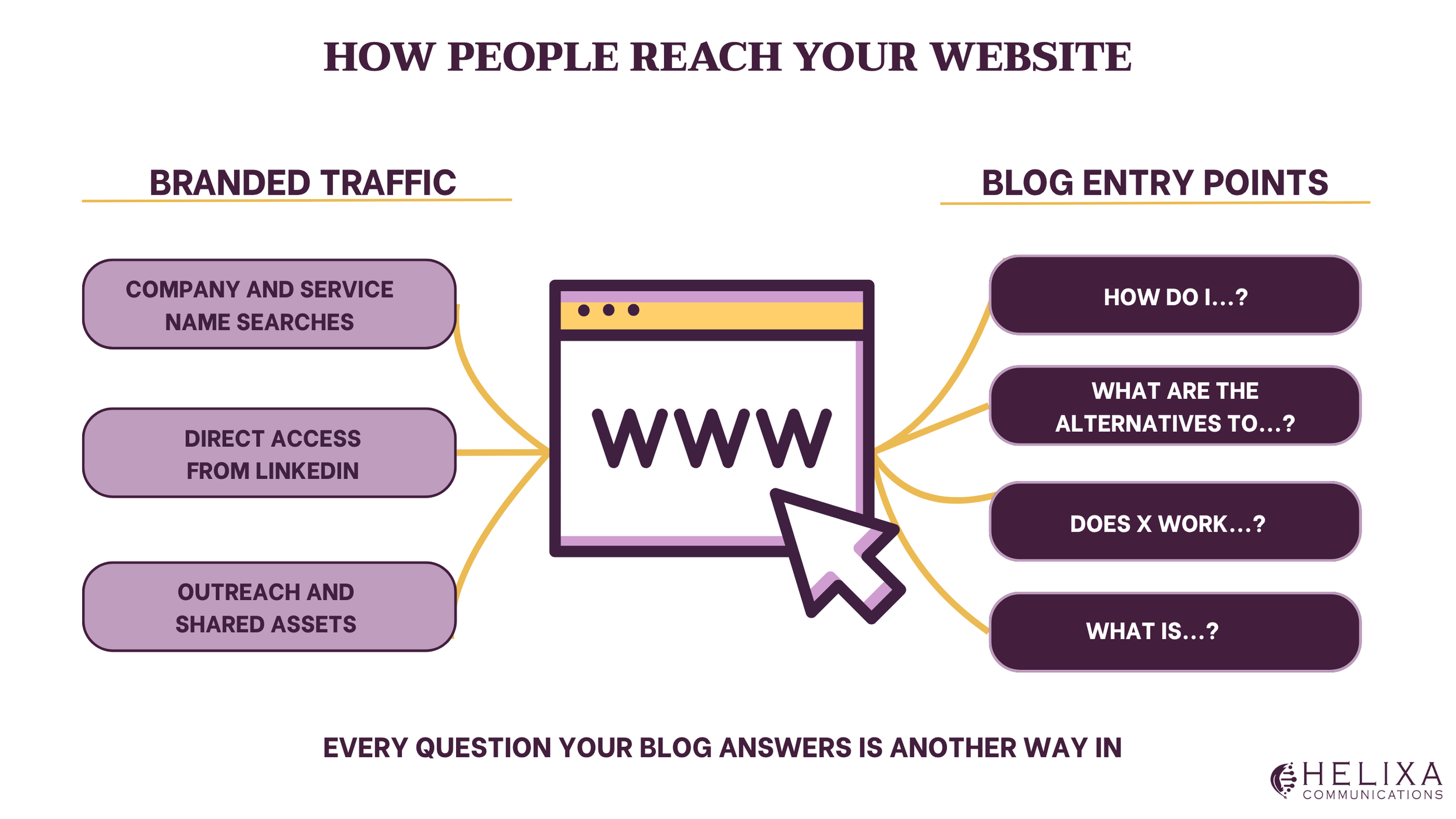
Every question your life science blog answers creates another route for prospects to find your website.
Your website is not building authority
Once you know SEO and keywords matter, you may be tempted to use AI to churn out articles. I get it: in just a few minutes, you can generate a bunch of content full of keywords.
The problem here is value. Google is increasingly promoting content that’s genuinely useful for the people reading it. So, if you want Google to show your website in the first positions, you need to signal experience, expertise, authoritativeness, and trustworthiness. This is the quality evaluation framework used by Google, usually known as E-E-A-T. In simpler words, Google values things like:
People-first content: answering real user questions and bringing in real-world experience (check the latest’s Google update here).
Nuance: talking about when your product works and when it doesn’t, who it’s for, and who it’s not for.
Recent research and scientific advances: keeping your content up to date with the latest evidence in your field.
And to be honest, it’s very unlikely that you can do all of that in your home and services pages. Especially when working with scientific topics, the depth and number of questions are simply too broad to cover them in two pages.
A blog section is the perfect solution for that. It’s the place where you can generate as much content as you want to answer those real, highly intentional questions your prospects need to solve. You can also talk about your scientific expertise and how your field is evolving. This way, you create multiple entry points to your website, rather than relying solely on branded traffic.
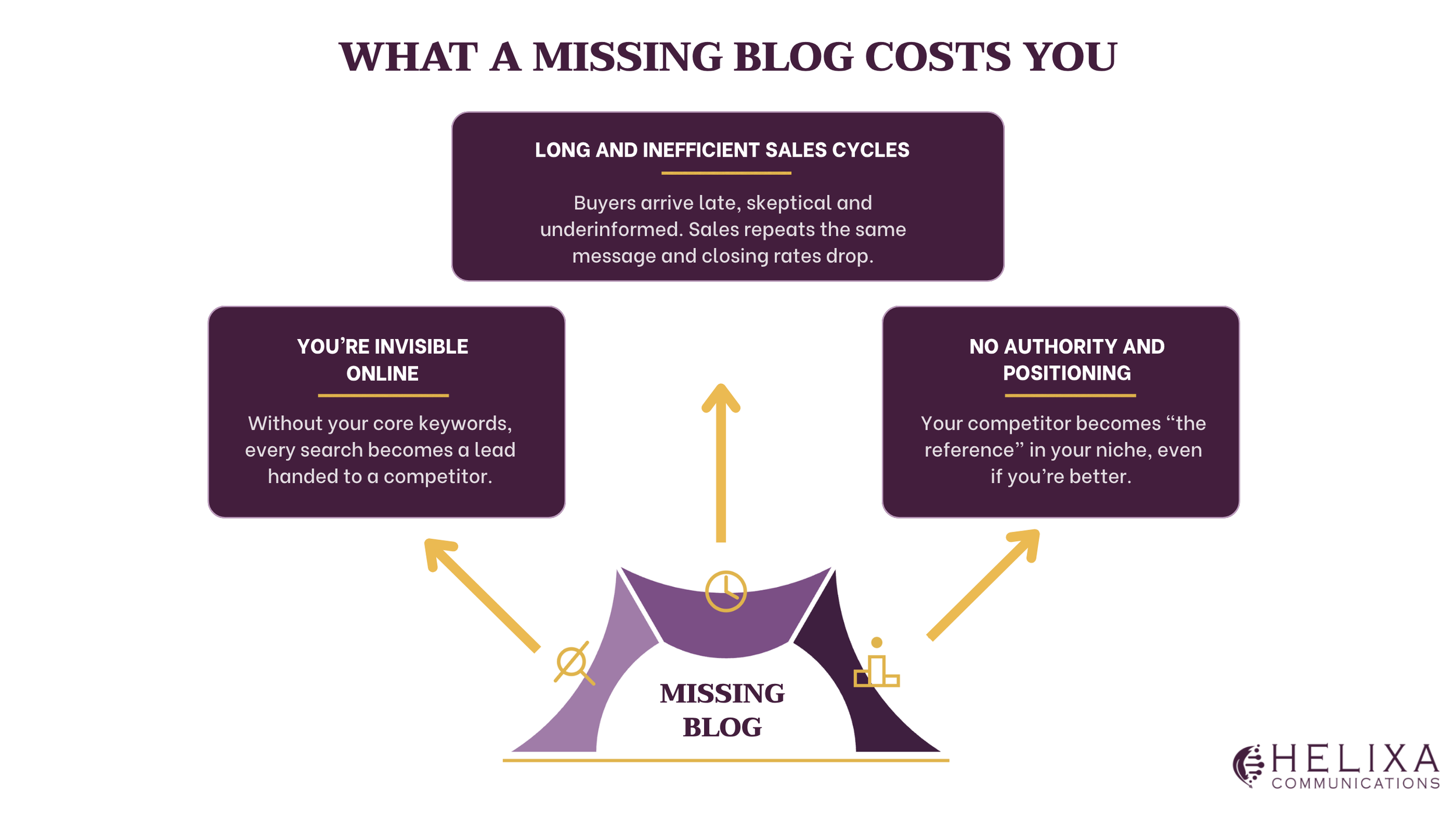
Without useful educational content, buyers have fewer ways to find your company and assess whether your solution fits their needs.
If done right, a blog section is also a great way to gradually educate your clients on why your company or solution is the best, or not the best, for them. Without investing in sales calls and long conversations, readers can find out themselves whether they’re the right fit before contacting. And if they do contact you, they’ll already have many of their questions answered. In life sciences, this is key, as buyers need useful information at multiple decision points: an early explanation of the technology, application data, specifications, validation evidence, and material they can share with colleagues.
How to build a life science blog that attracts and converts prospects
So now that the value of having an updated blog section is clear, let’s talk about how to actually do it. Because relying on AI to write random articles is not going to do the job. The main steps to produce a strategic life sciences blog section that helps you rank and convert include:
Have your positioning and messaging crystal clear.
Before going crazy with keywords, you need to know what your company does, who it helps, what problems it solves, and why your expertise matters.Think about what your clients are actually searching for and why.
Using Google People Also Ask questions, checking competitors' websites and forums, and using tools like Google Keyword Planner will help you find the words and questions your readers look for. But you also need to answer the why behind them: are they trying to understand a technology, solve a specific problem, or compare two solutions? This is search intent, and your content should be obsessively created to match it. Think of keywords as a way to understand your audience, not just words to stuff into an article.Choose topics where you have a realistic chance of being found.
You don’t need to go after the most competitive keywords from day one. Start with relevant, lower-competition topics and use related content to gradually build authority around broader ones.Create with strategy.
Instead of publishing random articles, build a comprehensive life sciences SEO strategy around your audience’s questions, relevant keywords, search intent, and your expertise. Use FAQs, real questions, and relevant subtopics to make the content useful for both readers and search engines.
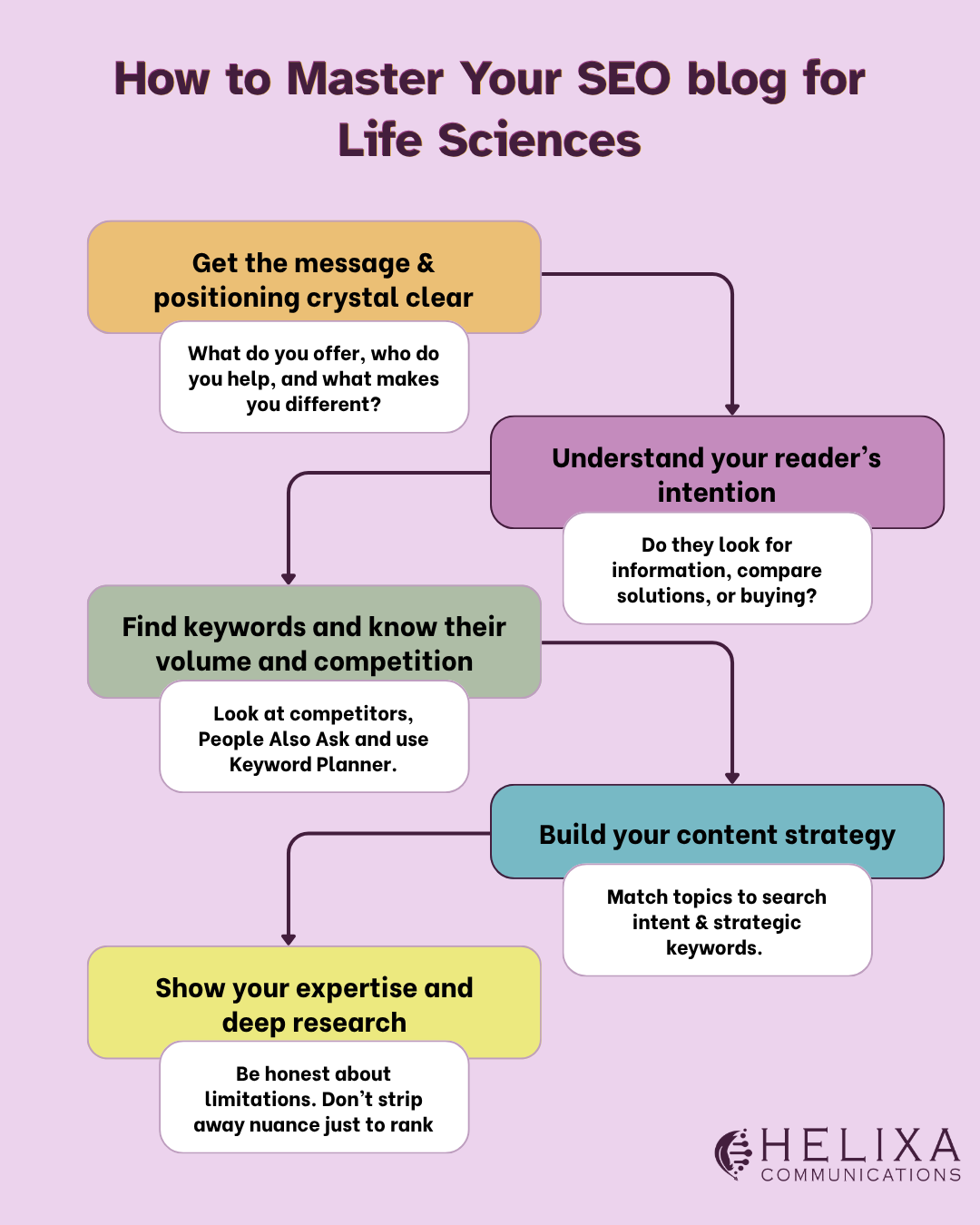
An effective life sciences SEO blog starts with clear positioning, research into buyer questions, and evidence-based content.
All these steps will guide you to produce a resource center that will help you rank, drive traffic, and educate your clients. It takes time, but it makes the effort and money you invest in your science and your website worth it.
How we can help with your life sciences SEO
As always, you can do this alone or ask for help. If you opt for the second, we’re here: a PhD team that blends scientific, copywriting, and life sciences SEO expertise. We get your science, and we make it rank.
→ See how our blog articles get thousands of monthly impressions for a life science company
→ Want to work with us? Check out our services or book a call here.