How to start posting on LinkedIn (and actually enjoy it) if you work in life sciences
The world of writers and CEOs rarely aligns. In life sciences, though, I can say there is one question that all kinds of people ask me regularly: professional medical writers, scientific writers, biotech CEOs, executives, and founders. The question is always the same: “How do I start posting on LinkedIn?”
LinkedIn is the largest professional network in the world. It comes as no surprise that people actually want to be there, to try to create a community of like-minded people, achieve business goals, and generate revenue.
The platform is now filled with AI content and gurus who promise you can create a month of content with just four Claude prompts.
I have been active on LinkedIn since February 2025, and when I say active I mean extremely active: posting, networking, building relationships, and eventually building a business driven by this platform. This article is for those of you who have been wondering how to do the same, post consistently, actually get results, and enjoy it. The answer does not lie in four Claude prompts, sadly, but I promise you that the journey will be more rewarding than using AI.
Why life science professionals are afraid to post on LinkedIn
When we post something on LinkedIn, it becomes available to 1.3 billion people. 1.3 billion souls that can judge us, criticise us, or even just ignore us. This is why people ask about “how” to post on LinkedIn, when what they mean is “how to post in LinkedIn without sounding like an idiot, being ignored, or judged silently.”
That fear is at the root of why many stop before hitting “post” or procrastinate doing it for months. Good news: most everyone has gone through that phase, me included. Posting might become something super rewarding, even if many people don’t engage. But, to make it easier, I’ll give you some advice on how to actually do it.
If I had to sum up my advice to answer the question of “how” to start in the easiest possible way, I would head to my favorite slogan from the famous brand Nike: “Just do it.”
The advice is good because it will help you learn what you like and what you do not like about the platform. It will also make you learn what is rewarded by both the people and the algorithm and what is frowned upon. It will eventually get you somewhere, but that is going to be very time-consuming, and it does not answer the real fear of rejection.
So let me break down the answer of how to start posting not only to just do it, but to make it a rewarding part of your week quickly, and to enjoy it.
How do you start doing something that will ideally become part of your routine? It is not about what you want to be doing in one year or how successful you want to be on the platform. It is about what will still be sustainable and enjoyable for you in six, twelve, or twenty-four months.
It is very likely that something has already come to mind reading that. That something was probably immediately followed by: “How do I know that people will be interested in that?” “How do I know if I will be judged negatively for sharing those opinions?” The hard answer is you don’t. You never know that for sure until you hit post. Social media does not come with a safety net. But I promise you, you can try, and you’ll most likely find the journey really enjoyable and worthwhile, personally and professionally.
So, commit to giving it a shot, and now let’s give you what you need to make the most out of your attempt!
What makes people stop and read your posts
In a social network with 1.3 billion people, only about 1 to 3% of them post every week. That number is appallingly low, and most people are active just watching, reposting, maybe even dropping one or two comments. Many posts are bland, generic, and self-congratulatory. There is nothing wrong with that, but let us not pretend that those kinds of posts will make people want to connect with you, talk to you, and learn about you.
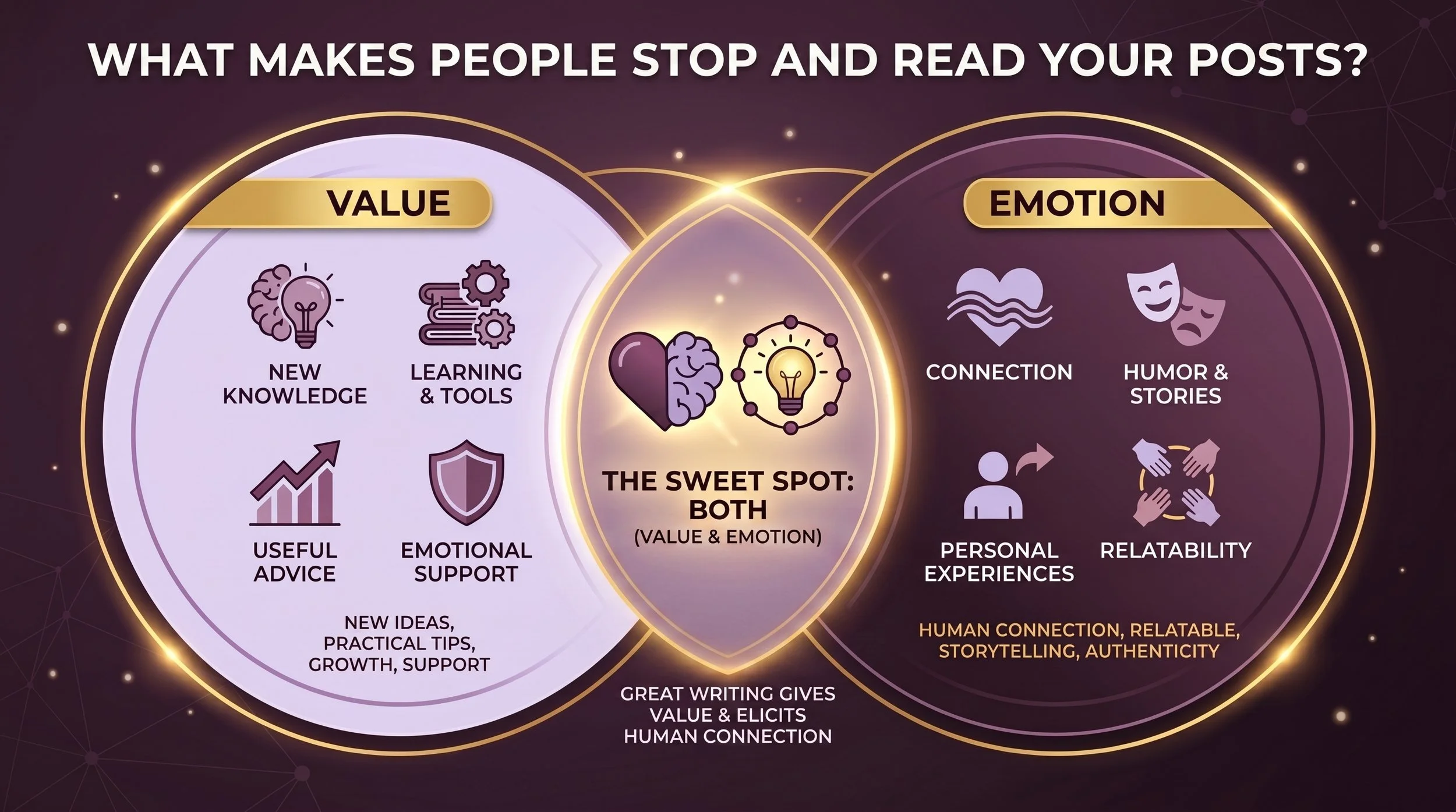
If I had to boil down every type of content that performs, all of it does at least one of two things:
Value
Value can be described as anything a person knows after reading a post that they did not know before. This could include a tool, a new scientific discovery, knowledge useful in their everyday life, emotional support, learning from your experiences so that they do not make the same mistakes, advice, tips, or even a new connection that posts something interesting.
Emotion
It does not matter whether we like it or not; we are emotional creatures. People will want to read you if they connect with you emotionally. That could show up as being funny, sharing personal wins and failures, talking about politics, your experiences in a way that makes others relate to it, and many other things.
Both
The best posts do both at the same time. Just like the best books, they give the reader something of value, but they make it easy and compelling to read by eliciting human connection and emotion. This matters in life sciences more than people think. Scientists, professional medical writers, and people in biotech often assume that LinkedIn content has to be dry and purely educational. It does not. Scientific communication on LinkedIn works better when it gives people value and also sounds human.
Stories outperform AI content on LinkedIn
This conundrum leads me to my favorite part of LinkedIn and writing in general: stories. Many creators will promise you that you just need to upload your voice to Claude or some other LLM and generate dozens of posts with a short prompt. You can absolutely do that, but people have wised up to this trick pretty fast.
Emotion and human connection are things that AI does very, very poorly. The result is that AI-generated content is usually only read for value, and you are missing 50% or more of the results you can get from LinkedIn.
Most of your knowledge comes from experience. Everyone else has probably done a bachelor's, attended university in some way or another, and can read an article just as fast as you can. This means that the valuable knowledge (i.e. not easy for others to come by) you have comes from personal stories. I would urge you to share those as a medium to transfer value. AI can never get full access to your life, cannot have the lived experiences that you have, and cannot react in an unpredictably human way as you do. Those are your stories, and that is what you should post.
Is LinkedIn the new Instagram? How to choose what to post
Discussing personal stories with people eventually leads to the point where they feel uncomfortable. They tell me that they are on LinkedIn for business, not for pleasure, and that sharing personal stories is not something they necessarily want to do. This makes complete sense, and it is okay to feel worried about sharing personal details with random strangers.
The problem is exacerbated by the fact that LinkedIn feels very performative sometimes, with people posting thought-leadership-wannabee things like “what seeing my wife give birth taught me about B2B SaaS” or “what breaking a leg on a skiing vacation taught me about resilience in the workplace”. Both sound unhinged because they link two completely unrelated sides of people's lives, and they are extremely performative.
The solution is much easier than people think: simply post about your business life. The way that you think, the way that you approach business decisions, what you have learned, and how you experience the business world are always going to be valuable for people who are going through the same things or want to.
In the case of scientists, this can often show up by discussing science through the lens of someone who does it. For example, how does it feel when your paper is finally accepted? If you share a story about how you were in the lab when the “accepted” news came and you left the gel you were running to go celebrate, forgot about it, and came back hours later to find all of the bands gone because they had migrated out of the gel, that is a funny story that makes you very human, and you can still share the details about the paper. The same applies to professional medical writers, scientific writers, biotech executives, and founders. You do not have to invent a personality online. You just have to share your professional life in a way that is genuine and readable.
How to use LinkedIn to move your life sciences career or business forward
If you want to post on LinkedIn, it is probably because there are goals you want to achieve. You might be wondering how any of what we’ve discussed really gets you anywhere when it comes to generating revenue opportunities and improving your professional life. For that to happen, you have to link posts and content with business goals.
Imagine this: you have posted for six months and you have crushed your goals. Now walk backwards. Who read your posts so that those goals could be achieved? Maybe it was a possible employer, another CEO or founder, a business developer from big pharma, a professional medical writer, or all of the above. Regardless, answer the question and make a list.
The second point is: what should those people know about you that will make them want to help you achieve your goals? That could be hiring you, working with you, or reaching out for a partnership. Answer this in full.
Now go one step further. Who are the people closest to your role who are connected to those who can move your business goals forward? If you target a very narrow niche, it will be hard to get visibility. For example, if you target startup founders to get hired, the broader group could be business developers, HR people, or scientists in industry. If you can create content that targets both people in and adjacent to your field, you will create content that is relevant to a lot of people and that can create the opportunities that you need.
The hardest part
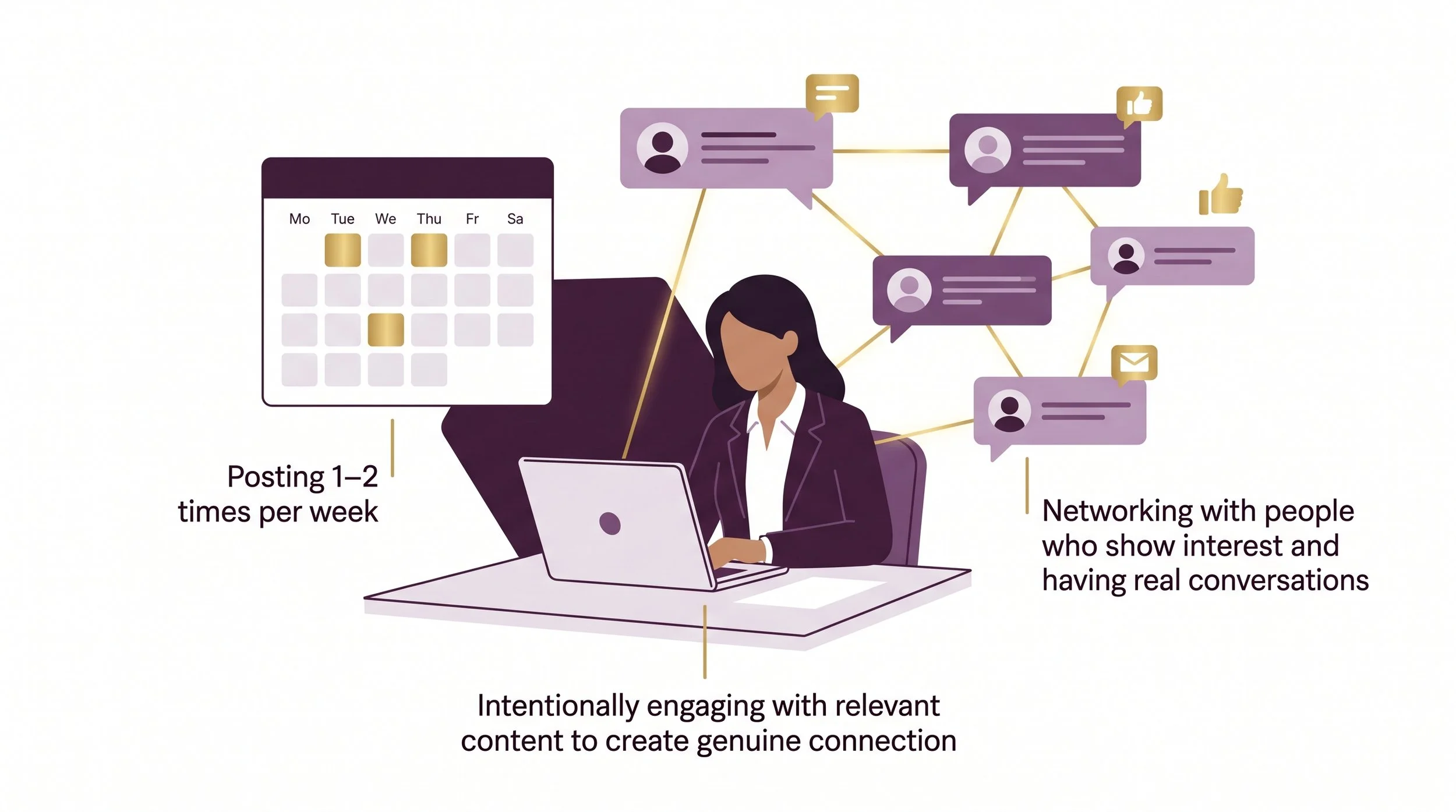
What’s left is just doing it. Post at least twice a week. Network aggressively with those who interact with your content. The people who engage are already primed to want to know more about you. Be nice, talk to people, ask about what they do and why they found your content interesting, and then see whether they can provide opportunities for you and your business.
Do to others what you would like them to do to you. If you want people to engage with your content, you should do the same. Look out for people who are your peers or your target audience and actively engage with their content whenever you have something of value to add.
Note: If you want concrete steps to do this, you can check our second blog on this topic, or our free 30-day guide with defined steps to get you to post for a whole month and improve your business opportunities!
The algorithm
As for the algorithm: the best thing you can do is write for people and not for a machine. The algorithm changes constantly, and people will always be on the other side of the screen while the algorithm is volatile. Optimizing for the first is the only rational choice if you want to get started and stay consistent.
We have more materials on our resources page, and there will be more blogs on this topic to come. Follow me and Helixa Communications on LinkedIn, and if you are wondering whether our services might be of help, book a meeting through the Contact Us page or simply DM me on LinkedIn.