The risks of AI-generated content for agrobiotech companies on LinkedIn (and what to do instead)

Building a successful business is not easy, especially when it involves science. If you work in an agrobiotech company, you know the challenges firsthand: complex R&D, developing new biologicals, navigating convoluted regulatory frameworks, and producing validated data.
The last thing you’re thinking about is your company LinkedIn content. So you know what’s coming after this: you use Claude to produce your posts. And hey, it does the work; you don’t need to rely on anyone else, and you get your LinkedIn company page running.
It is not a bad solution, as long as you don’t think about the consequences. Read the full article to find out what the hidden risks are of relying on AI for your content, find examples to create posts that really drive new opportunities, and understand how LinkedIn is starting to cut the reach of AI-generated posts.
TL;DR
Many agrobiotech companies use AI to keep their LinkedIn company pages active.
AI outputs are usually generic and full of buzzwords, so they say nothing specific about products or grower problems.
This generic tone damages reach, trust, and ultimately sales for biologicals and biostimulants.
LinkedIn’s 2026 algorithm update is starting to downrank this kind of repetitive, low-substance content.
Teams should use AI only as a support tool and then add their own agronomy details, field experience, and human, relatable perspective.
The real consequences of AI LinkedIn content go beyond reach
When people consider using AI for their company content, they think the main consequence is lower engagement and reach. And this is true: people are tired of reading the same generic content, and when they see another repetitive post, they just don’t engage.
This makes AI-generated posts reach fewer new people as well. But I know I got you thinking: “Ok then, I may not reach as many people or get as many likes as with human content, but hey, I don’t need to hire an extra human, nor invest a lot of effort. It’s a fair balance”.
There is yet another consequence many ignore, and this time it is about trust. If your content only contains corporate, vague sentences with no clear expertise or differentiation, readers get the subconscious message that you just don’t understand their problems or have real experience. This happens with both new leads and, worst of all, the ones that have already followed you for years. The same content that doesn’t reach people is the one that makes you look untrustworthy to clients.
This is not only an AI problem: this generic and untrustworthy content already exists across LinkedIn before Claude was all over the place. AI amplifies this trend by making it easier to produce at scale and by reinforcing low-quality patterns through automation.
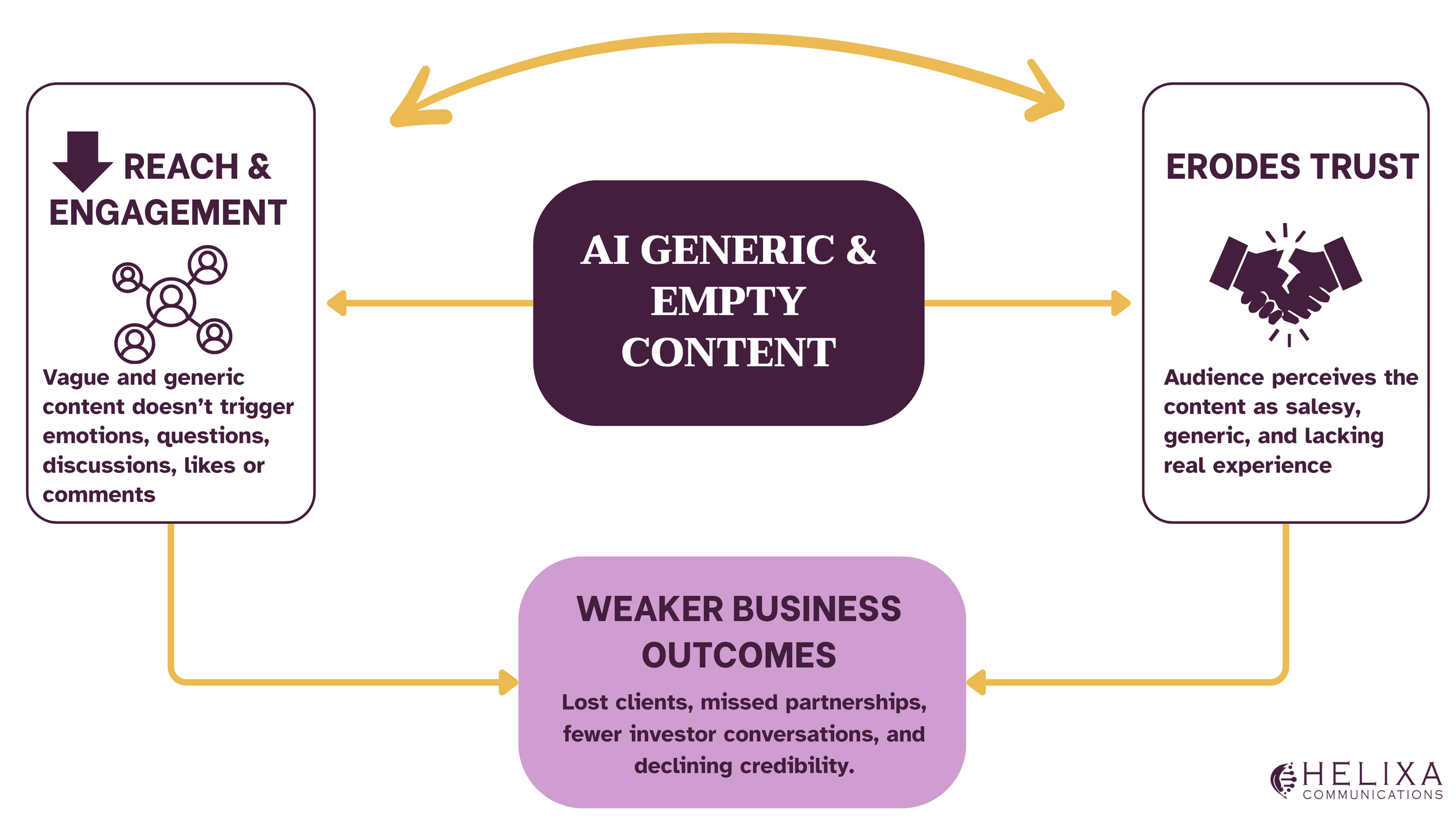
Generic AI LinkedIn content traps agrobiotech companies in a loop of low reach, eroded trust, and weaker business outcomes.
The feedback loop between reach and trust
These two problems feed off of each other. If people don’t trust your content, they stop engaging. This means fewer comments, shares, and saves, which signals the algorithm to show your posts even less. Low engagement also signals to readers that your content is not useful and thus not trustworthy.
The point of trust and engagement is not to have a nice-looking profile full of likes and views. LinkedIn is a gate to new clients, partnerships, conversations, and investors. Trust and reach are the two keys you need to open the gate, and AI content the way you can backfire on business outcomes.
Not all is bad about AI content, though. By analyzing why AI content leads to low engagement, eroded trust, and missed opportunities, we can understand what NOT to do with our posts to drive results. Let’s break this down with some examples!
Why AI-generated LinkedIn posts fail for agrobiotech companies
The best ability of AI is to write content that actually says nothing. AI LLM models are very good at creating plausible text, but not at prioritizing what’s important or creating opinions. Plus, it doesn’t have your experience. So when it needs to fill a 3-paragraph post, it will use generic sentences, buzzwords, and vague statements that sound fluid but say nothing.
From vague AI copy to a concrete field trial story
To illustrate this, I’ve created a post using Claude of an invented company selling microbial products for farmers. I asked Claude to produce a post about the first field trial of their product:
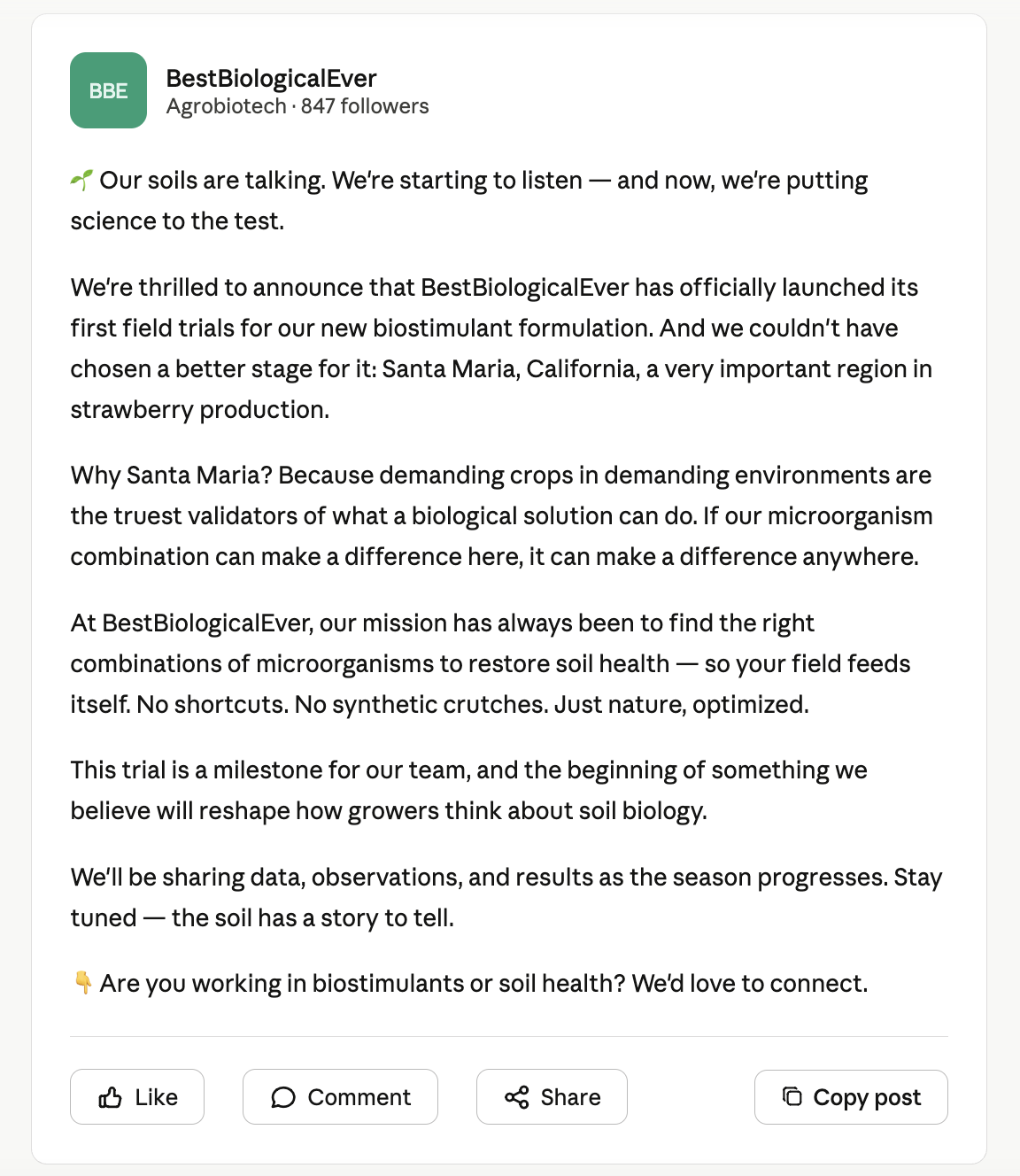
Example of a LinkedIn post generated with AI for an agrobiotech company
The only information we get from this post is that you run a field trial in strawberries in Santa María with a microbial product. Nothing more. If you go and post that summary sentence, you’d get the same result: very low reach and engagement. The reason is simple. With no substance, your post doesn’t trigger any emotion, question, or discussion in your reader, so they simply ignore it.
Adding details: your best tool to engage LinkedIn readers
Following the example, we could replace the empty sentence: “Why Santa María? Because demanding crops in demanding environments are the truest validators of what a biological solution can do.” with more information about why Santa María area is actually demanding: “Growers in Santa María face a special challenge: they grow one of the most sensitive crops to salinity, strawberry, in a region where irrigation water can reach EC 2 dS/m. That’s exactly why we chose this location, to test our bioestimulant, based on salinity-resistant bacterial strains, in fields that are actually suffering from these challenges”.
This will more likely fire conversation, engagement, and thus reach. Growers will feel understood because they live these challenges; people considering growing strawberries can feel grateful for learning more about this crop, and others who know best practices to approach it will add value to the conversation.
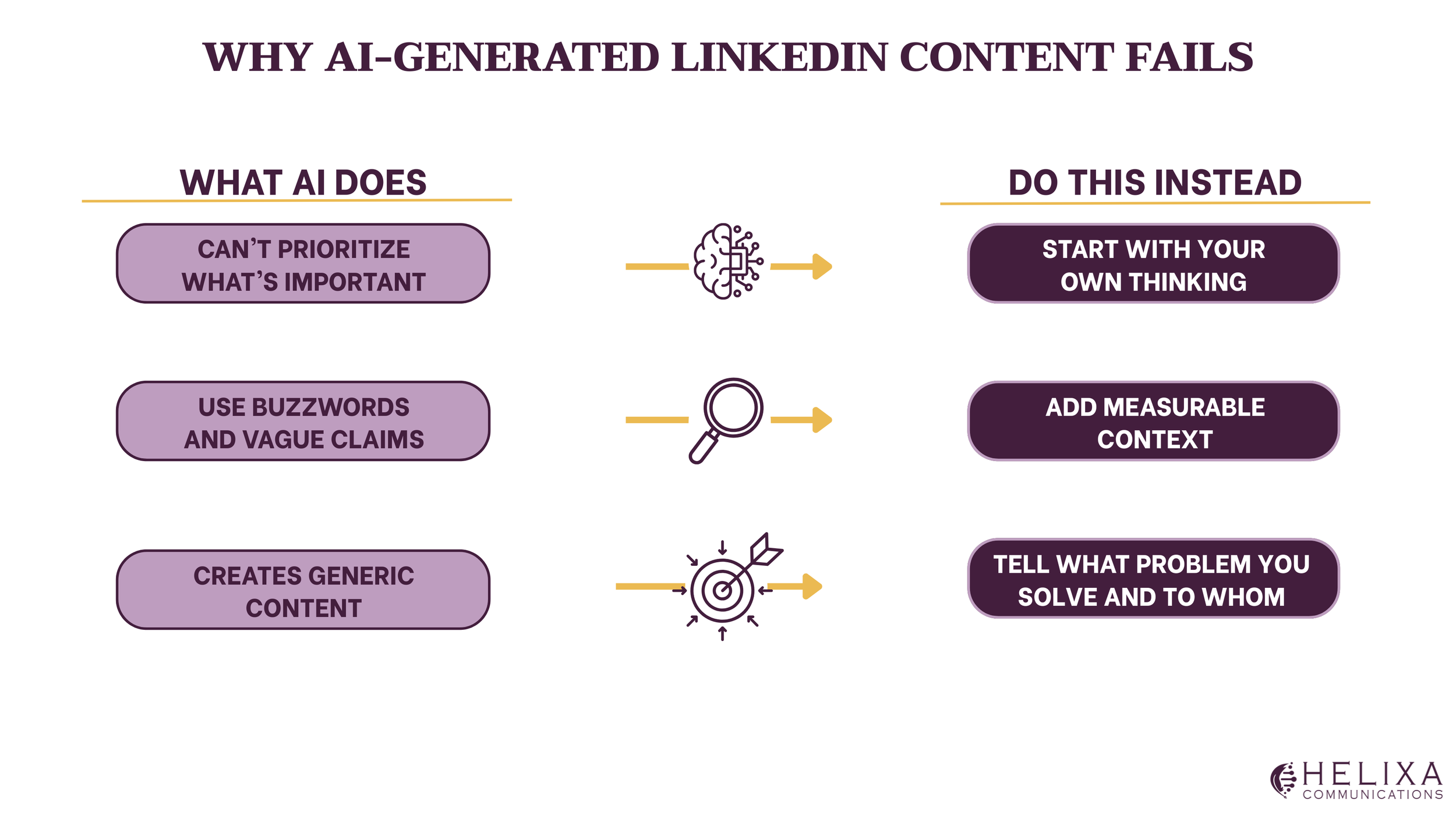
AI-generated LinkedIn content fails because it produces generic, buzzword-heavy posts that say nothing and don’t differentiate your company. Instead, use specific language, prioritize your own thinking and ideas, and talk about experience-based updates.
Use AI content if you want to sound salesy
What comes next is trust. Empty language has a high risk of sounding salesy, signaling to readers that you’re selling something without backup data or thoughtful decisions. This is what happens with expressions like “truest validators” and “the right combination of microorganisms”. Why are these validators the truest? And why is this combination the right one if you’re still testing it? Replacing those with clear information, like “our bioestimulant, based on salinity-resistant bacterial strains” gives readers something concrete to evaluate, and thus to trust you.
Signals that tell readers you know what you’re doing
Now take our AI post example and plug in any biological company name into it. With minimal changes, it will work.
That’s what generic content means, and it’s the best recipe to lose trust. Imagine an investor reads the previous post. In a crowded market, sentences like “Our mission is to find the right combinations of microorganisms to restore soil health — so your field feeds itself” don’t differentiate you at all. Moreover, it makes your biological look like a magical solution that doesn’t account for complex constraints such as environmental variables or soil composition. If your product is no different, and there is no evidence on how it works, why trust it will give different results?
Specific content works the other way around, making you easily stand out: “Our focus is to combine salinity-resistant microbial strains that act at the three levels of plant response to salt: root growth, ion balance, and photosynthesis.” This one line provides high-value content, showing you have the expertise and hands-on experience with real problems in the field.
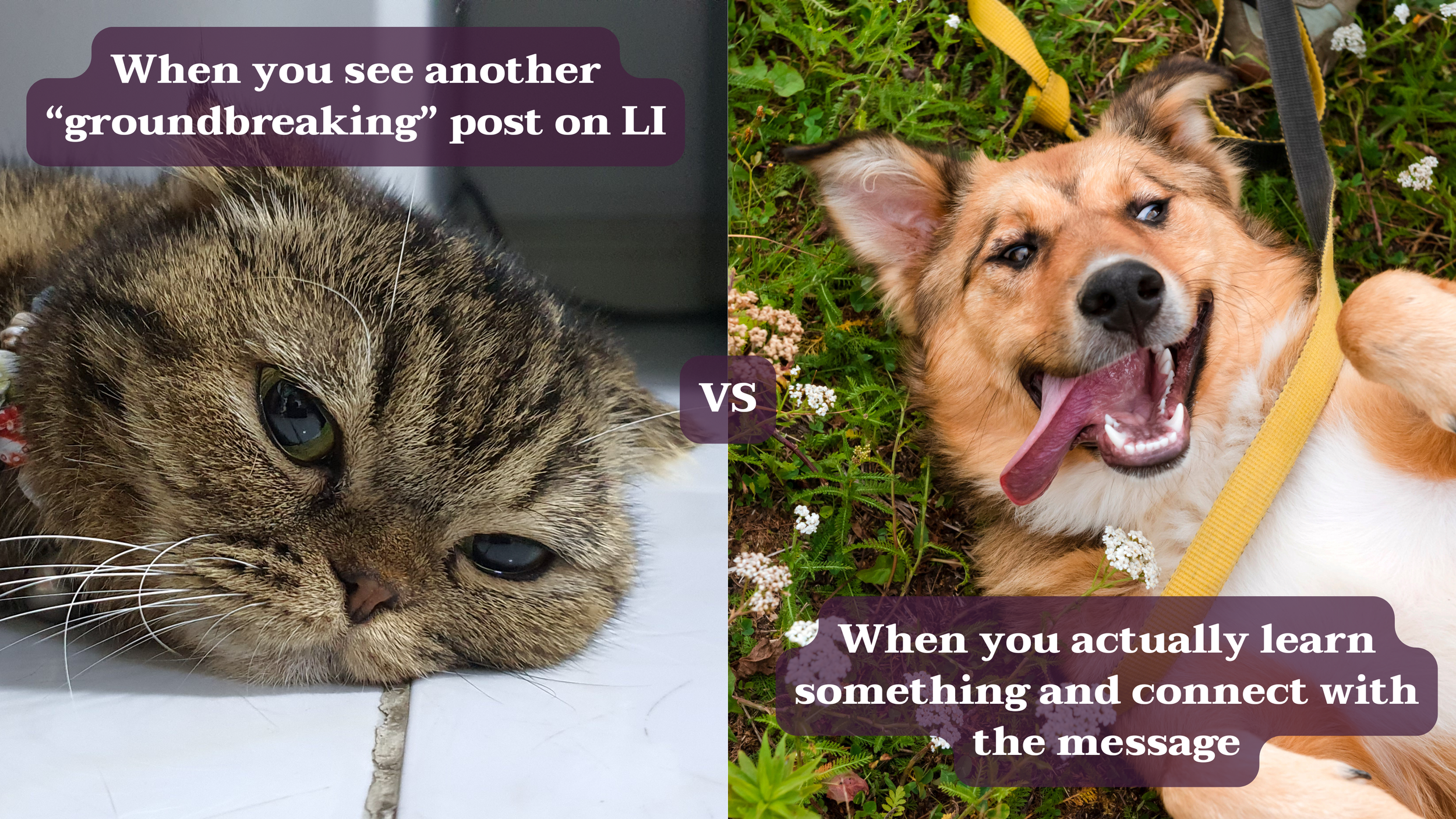
Generic LinkedIn content makes people bored. Unique perspectives like the one in this image make them not.
If you sound like anyone else, why bother?
And as generic content doesn’t differentiate you, it makes you lose engagement and reach as well. When everything in their feed looks and sounds the same, people get bored. They’ve already seen this “feeding your plant when it needs it the most” or “groundbreaking innovation” a hundred times already. They will simply not bother to read it closely and react.
All of the above-mentioned impacts on reach are especially important for LinkedIn company pages, because these are shown to far fewer people by default. In fact, recent analysis shows that company pages feed only 2% of the LinkedIn posts. This is another reason why you should take special care of your company page content, and why investing in personal profiles or ghostwriting programs is a great option alongside creating original content for the comapny page.
What LinkedIn's 2026 algorithm update means for your company page
The cherry on top comes from the latest updates on the LinkedIn algorithm. Laura Lorenzetti, VP at LinkedIn, recently stated that generic and repetitive content will reach significantly fewer people. Instead, unique perspectives, expertise, and context will be highly valued.
This means AI can still support content creation, but it works best as a tool, not a source of original thinking. Researching, brainstorming, and polishing are great utilities of AI, only if you prioritize your own perspective and experience. That’s what will make you stand out.
Throughout this article, we've shown how to do that: avoid buzzwords, add specifics instead, explain how your product works, and focus on the problems you solve. In other words, create content that feels human and relatable.
Or hire a human to do so. They offer several advantages: they challenge ideas, tell you when something is wrong, and understand emotions because they themselves have them. So if you’d like support from two PhD humans, go check out our services.
Frequently Asked Questions
1. Why is AI-generated LinkedIn content risky for agrobiotech companies?
AI-generated LinkedIn posts sound polished but empty, recycling generic claims that fail to show real understanding of crops, environments, and regulatory constraints. This makes your biologicals or biostimulants look indistinguishable from competitors, erodes trust with growers and investors, and increasingly triggers LinkedIn’s algorithm to limit your reach.
2. How does generic AI LinkedIn content affect reach and engagement?
Generic AI LinkedIn content usually leads to fewer comments, saves, and shares because it doesn’t trigger emotions, questions, or discussion. As engagement drops, the algorithm shows your posts to fewer people, creating a feedback loop where low interaction further reduces reach, especially for company pages that already get limited feed exposure.
3. What does AI-written “empty” content look like in agrobiotech posts?
In agrobiotech, empty AI content often looks like long updates about “groundbreaking biological solutions” that never mention specific crops, stress factors, trial conditions, or mechanisms of action. For example, a field-trial post might sound inspirational but omit key details such as salinity levels, microbial strains used, or what changed in plant response, giving readers nothing tangible to learn or trust.
4. How can agrobiotech teams fix AI-generated LinkedIn posts so they perform better?
Agrobiotech teams can improve AI-generated LinkedIn posts by starting with their own thinking. It’s crucial to add concrete details, field-trial data, and clear explanations of how their biologicals work. Swapping buzzwords for specifics (such as crop sensitivity, environmental constraints, or microbial mechanisms) transform your simple update into a useful story for readers.
5. Does LinkedIn’s 2026 algorithm update penalize AI content directly?
LinkedIn’s 2026 algorithm update is penalizing content that’s generic, repetitive and vague. If an agrobiotech company publishes AI-written posts without adding its own insights, those posts are more likely to be classified as low-value, get less distribution in the feed, and miss opportunities to reach new clients, partners, and investors.